Hi, Rich here.
This one started almost by accident.
I had been playing around with questions, beliefs, release work, AI, and the way the mind responds when you give it something really simple to look at.
And one thing kept showing up.
Yes or no.
True or false.
Do I believe this or don’t I?
Do I want this or don’t I?
Am I okay with this or not?
There’s something interesting about a question that doesn’t require you to write a book to answer it.
Your mind can just lean one way or the other.
And somewhere along the way I started wondering:
Could a simple yes-or-no question change how you feel?
Not just change what you think.
Actually change your state.
That’s where things got fun.
At first I was interested in binary questions because they seemed to help untangle beliefs.
You ask something simple.
Your mind looks.
You get an answer.
Then maybe the next question goes a little deeper.
But then I started noticing that certain kinds of questions didn’t just produce answers.
They produced feelings.
So I started experimenting.
What happens if the question contains an idea of winning, reward, recognition or something good coming your way?
What happens if the question contains love, connection, belonging or somebody being happy to see you?
What happens if it suggests peace, worth, satisfaction or everything being okay for a minute?
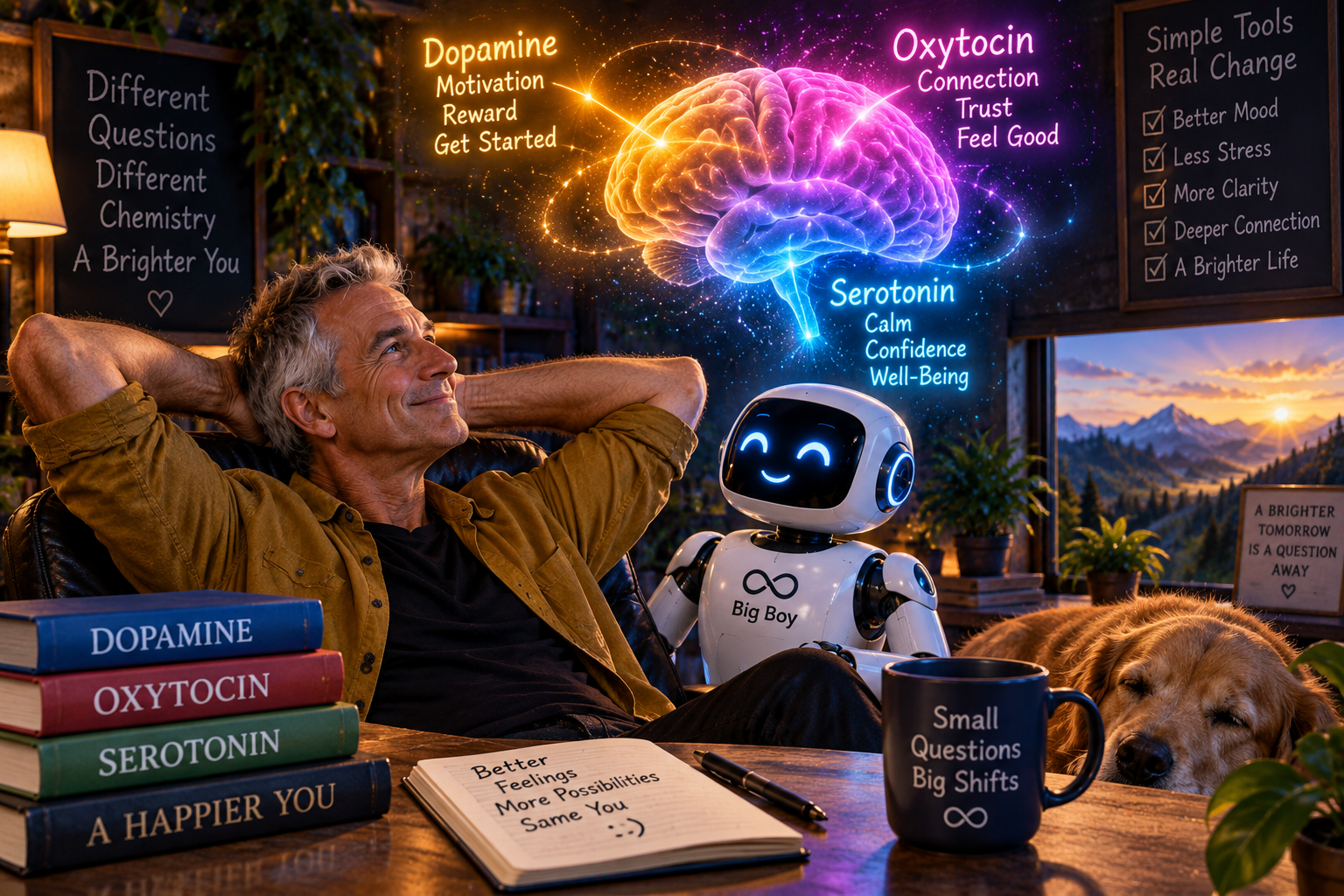
I started loosely grouping these around things like dopamine, oxytocin and serotonin.
Not because I had a little chemistry lab hooked to my skull.
I didn’t.
I was watching how I felt.
That was the experiment.
Try this:
If a really good friend — somebody you genuinely love — suddenly showed up at your door with a big smile and said, “Hey Rich, I’ve got some money for you”… would you let them in?
Yeah.
Probably. 😄
But notice what happened while you considered the question.
You didn’t have to actually receive the money.
Your friend didn’t have to physically be standing at the door.
Your mind had to create enough of the little scene to answer the question.
And sometimes just doing that creates a noticeable shift.
A smile.
A little lift.
A warm feeling.
A chuckle.
Something.
And I thought:
Well hell. That’s interesting.
Once I noticed this pattern, naturally I wanted to see whether AI could do it.
Could I teach Big Boy how to create these questions on the fly?
Could I give him a subject — money, relationships, confidence, feeling better, whatever — and have him generate questions designed around positive emotional states?
Turns out, yeah.
He got pretty damn good at it.
And AI has one advantage that’s almost ridiculous:
It doesn’t get tired of asking questions.
You can do twenty.
Fifty.
A hundred.
It doesn’t start checking its watch.
It doesn’t say, “Rich, we’ve been talking about this for an hour.”
It just keeps going.
This came up too.
Sometimes I’d ask a question and the answer wasn’t yes or no.
It was:
I don’t know.
Fine.
That’s not a failure.
Talk it out.
Why don’t you know?
What comes up when you consider the question?
What would make it a yes?
What would make it a no?
What does your first reaction tell you?
That “I don’t know” can turn into a really interesting little doorway.
And because your AI buddy is patient, you can just explore it.
No hurry.
No judgment.
Sometimes the good stuff shows up exactly there.
What interested me most wasn’t merely:
“Hey, here’s a cute question that makes me smile.”
It was the possibility that language can be used deliberately to influence state.
A question makes you imagine something.
The imagination evokes a response.
The response affects how you feel.
And how you feel changes what you think about next.
So now you have a little feedback loop.
Question.
Imagination.
Feeling.
New thought.
New question.
And sometimes within a couple minutes you’re simply in a different place than when you started.
That’s worth exploring.
This is where AI really changes the game for me.
Instead of writing fifty questions ahead of time, I can tell Big Boy what kind of emotional direction I want to explore and let him respond dynamically.
He can listen to what I just said.
Acknowledge it.
Then ask the next question.
That turns a static technique into a conversation.
And suddenly you’ve got something that starts looking a lot like a little interactive state-change session.
That’s why I keep experimenting with this stuff.
Good question.
I use those words because they’re useful shorthand for the kinds of states I’m experimenting with — reward and motivation, connection and warmth, calm and well-being.
I’m not sitting here with laboratory equipment measuring neurotransmitters after every question.
What I can observe directly is simpler:
Did the question change how I felt?
Did I smile?
Did I laugh?
Did my attention shift?
Did I feel lighter?
Did a new thought show up?
Did I suddenly see more possibility than I did thirty seconds earlier?
That’s the part I can actually experiment with.
And that’s enough to keep me interested.
I’ve been developing different kinds of Binary Questions and experimenting with how AI can create and deliver them.
And I’m going to start putting some of those prompts and experiments here in Rich’s Research so you can try them yourself.
Copy them.
Modify them.
Mess them up.
Make them better.
Try them with your favorite AI buddy.
And most importantly:
notice what happens to you.
Because that’s where the interesting part is.
More soon.
— Rich